Case Study
Composite Landing Gear Struts
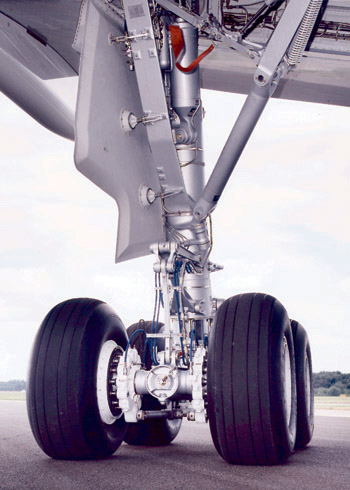
| The massive Airbus A340 landing gear, designed and manufactured by
Messier-Dowty at Gloucester with the aid of LUSAS software symbolizes state-of-the-art
engineering design. As part of continually advancing its designs, the company is using
LUSAS Composite to investigate the design of composite landing gear components with
the aim of reducing the cost and weight of future landing gear assemblies.
Under a government funded LINK Composite Structures
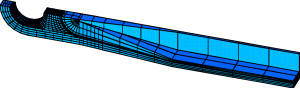
Scheme a composite landing gear strut was designed and tested. Using LUSAS, a linear
static analysis of three composite strut configurations was undertaken to determine the
optimum layup arrangement under compressive and tensile loads. Because of symmetry, only
one eighth of the strut needed to be modelled.
Advanced 16 noded solid composite elements
were used to model each section of the model and the LUSAS tied-slideline facility was
used to effectively 'glue' dissmilar meshes between sections together. Representative pin
loads were applied to the lug with boundary conditions being used for the free edges. Six
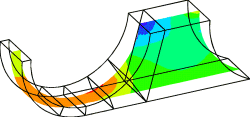
analyses in total (3 tension and 3 compression) were carried out. Peak shear stresses for
compression and tension analyses were obtained and an optimum layup arrangement of the
composite strut was determined by examining the shear stress distribution between the
different composite sections.
With help from
LUSAS the LINK scheme achieved its objective of advancing composite design technology on a
broad front covering analysis methods, failure modelling, the evaluation of new resin
transfer moulding systems and fabrication of engineering components. |
 |
|
|
|
As an extension to
this work another composite project known as CDAM (Composite Design Analysis Methods)
was also underatken. Funded by CARAD (Civil Aerospace Research and Development),
Messier-Dowty made use of LUSAS to, amongst other things, study the propagation of
damage under static, fatigue and impact loading. The project extended the
LUSAS interface element to model interlaminar failure; extended the 3D solid composite
element to model large deformations and increased the capability of both these elements to
model implicit impact problems. Work also extended the existing
LUSAS superelement
facility to cater for nonlinear and dynamic analyses.
Other LUSAS Composite case
studies:
|
|
Software Information
|