Software Tour
LUSAS Analyst /
Analyst Plus Overview
 LUSAS
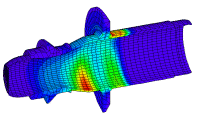
Analyst contains a comprehensive range of
unrivalled engineering analysis facilities to cater for all
types of engineering design. LUSAS
Analyst contains a comprehensive range of
unrivalled engineering analysis facilities to cater for all
types of engineering design.
From simple 2D linear
analysis of beams and plates through to advanced 3D
nonlinear shell and solid modelling, LUSAS Analyst
will help shorten your design and checking times giving
reliable results every time.
An intuitive Windows-based
graphical user interface gives easy access to the full range
of powerful modelling and results processing facilities,
together with on-line help.
Regarded as a leader in
engineering analysis, LUSAS Analyst is rich in
powerful and advanced features to meet your analysis needs
and extend your design capabilities.
Some illustrative uses of the software can be seen by visiting our
engineering case studies page.
 Ideal
for everyday analysis Ideal
for everyday analysis
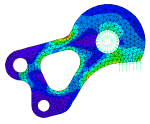
LUSAS Analyst comfortably
meets your everyday analysis needs. Unrivalled state-of-the-art
element libraries and material models allow all types of
engineering problem to be solved. Metals, plastics, foams, and
rubbers can all be modelled. Isotropic and orthotropic models are
available for linear static, linear buckling, and fatigue analyses
plus natural frequency analysis for determining mode shapes.
Better results in less
time
 LUSAS
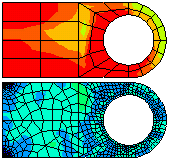
Analyst lets you do more in less time. All models are
created with built-in associativity allowing rapid design changes
to be made. Automatic meshing is available and user-defined mesh
arrangements are easily created. GUI results processing facilities allow
extensive contouring, graphing and plotting for rapid
interpretation of results. LUSAS
Analyst lets you do more in less time. All models are
created with built-in associativity allowing rapid design changes
to be made. Automatic meshing is available and user-defined mesh
arrangements are easily created. GUI results processing facilities allow
extensive contouring, graphing and plotting for rapid
interpretation of results.
Advanced analysis
and design
Unlike some systems, LUSAS Analyst
goes well beyond your everyday analysis needs. Advances in
technology require advanced software solutions. LUSAS Analyst
offers these solutions now to give you the edge over your
competitors.
- An easy upgrade from LUSAS Analyst
to LUSAS Analyst plus and associated options gives an
extended element set, additional material models, Fast
Iterative Solver Technology and access to advanced analysis
capabilities.
- A software key system means that
you can call us at any time for a key to unlock these powerful
facilities so that you can tackle new analyses straightaway.
Fully customisable
By using the advanced scripting
language, user-defined menus, forms and wizards can be added
allowing specific repetitive analysis tasks to be performed with a
minimum of user involvement. Complete analyses from modelling to
results processing can be automated - and all tailored to your way
of working.
Comprehensive
nonlinear analysis
LUSAS Analyst is also
rightly regarded as the leader in nonlinear
analysis with superior problem solving capabilities. Powerful
facilities for geometric, material and boundary nonlinearity are
available for problems involving large deformations, plasticity
and collapse. Fully automatic load incrementation, automatic
recovery from convergence failure and restart features are all
designed to enable newcomers to nonlinear analysis to quickly
become proficient in solving a wide variety of nonlinear problems.
Results processing facilities provide automatic load-displacement
graphs and viewing of yielded material.
 Impact
and contact analysis Impact
and contact analysis
For low or high speed impact and
contact problems LUSAS Analyst leads the field.
Contacting elements are automatically detected and specially
developed ‘slidelines’ and ‘slidesurfaces’ handle the
interaction that takes place at contacting regions, greatly
simplifying your analyses in 2D or 3D.
Dynamic
analysis
Forced response, vibration and
transient dynamic analysis
problems can be solved quicker with LUSAS Analyst and, if
you wish, by calculating the response for selected loadcases using
the Interactive
Modal Dynamics (IMD) results processing facilities. This gives
shorter analysis times and reduced disk usage compared to a full
transient dynamics assessment
 Thermal
analysis Thermal
analysis
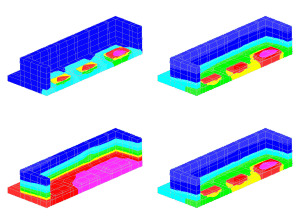
LUSAS Analyst has a
powerful set of thermal elements and extensive facilities for both
simple and advanced, steady state and transient thermal
analyses. Problems involving heat transfer due to conduction,
convection and radiation can all be solved. Effects due to phase
change of material can also be considered. If material properties
are significantly affected by temperature distribution then a
semi-coupled thermal/mechanical analysis can be performed. Changes
to the component shape can also be accommodated by a fully coupled
analysis.
Fatigue analysis
LUSAS performs fatigue calculations
on the results of a linear finite element stress analysis using
the total life approach. The fatigue life may be expressed in
terms of the damage that is done to the structure by a prescribed
loading sequence or as the number of repeats of the sequence that
will cause failure of the structure. Contour plots illustrating
the fatigue life of every part of the structure can be generated. More
details
Working from CAD data
Model information can be exchanged
with a wide range of CAD systems using industry standard exchange
formats such as IGES and DXF, as well as directly with specific
CAD systems using proprietary data exchange formats.
Software
products
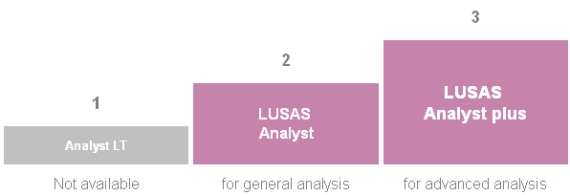
LUSAS
Analyst is
available in two software
levels; Analyst, and Analyst Plus to suit
your analysis needs. Each uses the same Windows user interface for easy and rapid model generation, load
application and combining of loadcase results.
-
Both
product levels use the same user interface and terminology, so training costs
can be minimised and users can be introduced to LUSAS at the most
appropriate level for the work they need to do.
-
There is also full
data compatibility across the products allowing easy migration of
a model to a more advanced analysis when required without any data
conversion or remodelling.
-
Separate
details list the capabilities of each particular software product.
Usage
-
Use
Analyst for linear static and linear modal dynamic analysis of
beam, shell and solid models.
-
Use
Analyst Plus for more advanced analyses using the appropriate
purchased option(s).
Element
sets
Software
options
The finite element analysis capabilities
of LUSAS Analyst software products can be extended by purchasing
additional software options.
Global
coverage and support
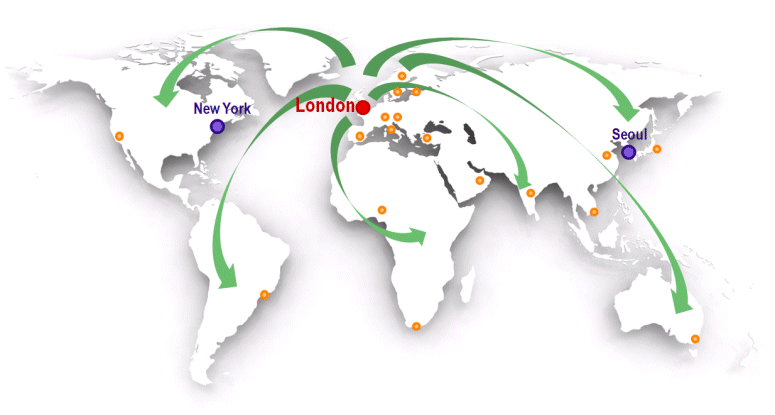
LUSAS software is
marketed and supported globally by LUSAS and also through a network of
distributors and resellers that cover every continent.
Used by thousands of
users, LUSAS is highly regarded in industry, as demonstrated by an impressive list of
clients, which include many of the top international consultancies.
LUSAS software is also used extensively by government agencies, local
authorities and smaller to medium-size consultants, many of whom find
that the advanced analysis facilities not only expand their
capabilities but also give them a competitive edge.
Universities and
research institutions throughout the world use the academic version of
LUSAS, which provides a steady supply of proficient LUSAS users to
support your use of the software in your industry.
Find out more
|