Software Tour
Analysis capabilities
Analysis capability is dependent upon the
product in use. The analysis capabilities of particular LUSAS Civil
& Structural software products can be
extended by using software options. For details see the Software Specifications.
Unrivalled state-of-the-art element libraries,
isotropic and orthotropic material models in LUSAS Civil & Structural, allow
all types of civil and structural engineering problem to be solved.
Multiple analysis
and branched analysis
When designing your
structure, more than one type of analysis can be defined and solved independently
from within one model using the multiple analysis and branched
analysis facilities. This means that, in most cases, there is no
need to create separate models and maintain clone copies of a model,
in order to analyse and view results for different analysis
requirements.
Analysis
branches allow the creation and solution of one or more sub-analyses
to investigate the response of the model at a particular loadcase or
"stage". Use analysis branches to:
- Carry
out a linear moving load analysis of construction equipment during
each stage of the construction.
- Perform
an eigenvalue natural frequency analysis or a buckling analysis
during construction.
- Perform
a phi-c reduction analysis to derive safety factors for a
geotechnical model from each stage in an excavation process.
- Perform
an earthquake analysis where gravity is applied in a static
nonlinear step, then the earthquake is run as a transient branch.
Several sample earthquakes may be run in each branch.
Linear static
Stresses, strains,
displacements, moments, shears and axial forces that result from
static loading are easily calculated, displayed and output from any
model. Loads are assumed to be
applied instantaneously in order to develop the state of internal stress and transient
effects are ignored.
Cable
tuning analysis
|
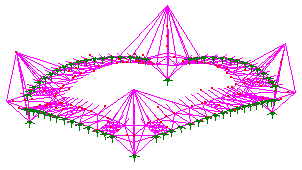
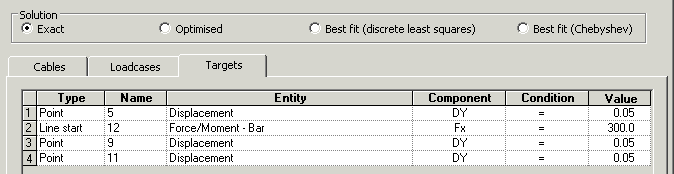
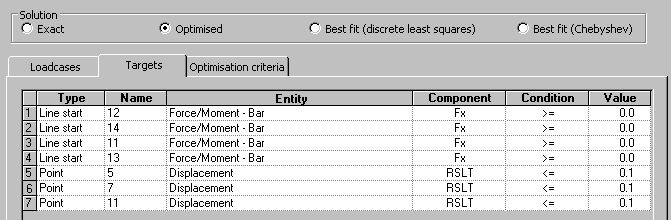
The cable tuning
analysis facility calculates load factors for cables in order to
achieve defined target values set for various feature types or results
components. An 'exact' method, an optimisation facility and two
best-fit solution methods are provided. |
|
Target values analysis
The target values facility is a
post-processing tool that provides a general method of varying load
factors in a linear analysis to try and achieve target values defined
for particular feature types or results components. The target values
loadset created is similar to a combination, but the load factors are
automatically calculated by the program in response to the defined
targets.
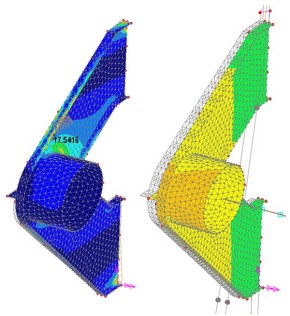
Buckling
LUSAS carries out
elastic critical buckling, which is required for the calculation of
member resistances. Often it is also required by some codes to
determine if a second-order analysis needs to be carried out. If so, a
full nonlinear buckling analysis can be undertaken.
-
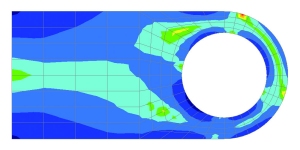
For structural
assessment, detailed buckling analysis with LUSAS can often reveal
additional ‘hidden’ capacity and prove load capacity.
-
For new structures,
linear and nonlinear buckling analysis using LUSAS can investigate
girder stability during erection, look at the effects of a slab
casting sequence, and also help to optimise the size of the web
and flange plates, bracing, stiffeners and position of any
temporary supports used.
|
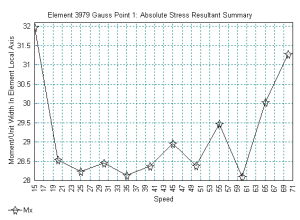
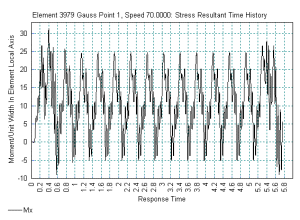
Fatigue
Fatigue
calculations can be carried out using the total life approach.
Fatigue life may be expressed in terms of the damage that is done
to the structure by a prescribed loading sequence or as the number
of repeats of a sequence that will cause failure
|
|
Dynamics
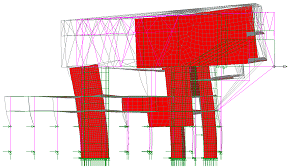
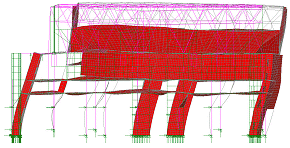
LUSAS Civil &
Structural excels in solving seismic and general dynamics problems.
The natural frequency of structures, the effect of dynamic loading,
such as crowds in sports stadiums and auditoriums, structural response
due to earthquake or impact loading, and blast loading can all be
readily assessed.
Interactive Modal
Dynamics (Modal superposition)
Interactive Modal
Dynamics (IMD) allows the natural vibration behaviour of a structure
to be combined with a loading regime in order to calculate the dynamic
response of a structure to a range of applied excitations. IMD
produces results an order of magnitude faster than traditional
time-step solutions. Multiple and more advanced loading events
(including moving loads and nonlinear behaviour) can be modelled with
the IMDPlus and additional software options.
Nonlinear
|
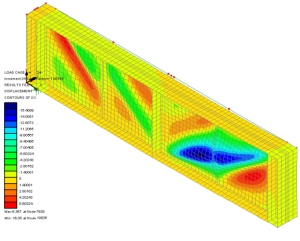
LUSAS Civil &
Structural handles geometric nonlinearity, material nonlinearity and
contact nonlinearity to accurately model the structural behaviour.
Local and global nonlinear analysis with LUSAS helps ensure that
structures are designed economically and safely for any imposed
loading. Automatic nonlinear solution procedures simplify the analysis
process for applications such as:
-
Time-dependent
dynamic analysis
-
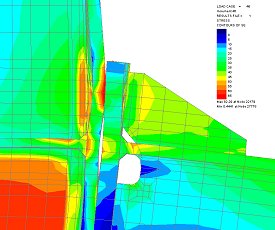
Lift-off of bearings
and halving joints
-
Bearing analysis
-
Elasto-plastic large
deflection plate buckling
-
Concrete cracking
-
Concrete creep with
recovery
-
Thermal loading
-
Impact / collapse
assessments
-
‘Push-over’
analysis
-
Excavation and
construction
-
Soil-structure
interaction
|
 |
P-Delta
analysis
P-Delta analysis
is available for bar, beam, thick and thin shell, and 2D and 3D
continuum elements with GNL capability. P-Delta analysis is an
approximate geometrically nonlinear (GNL) analysis typically used to
take account of the interaction between vertical and horizontal (sway)
loading on tall, slender buildings. Vertical constant loads (usually
dead loads) are used to form the geometric stiffness (stress
stiffened) matrix for the structure; additional live load cases can
then be applied and load combinations used to capture the effects of
the interaction between lateral and vertical loading.
Thermal / Field
analysis
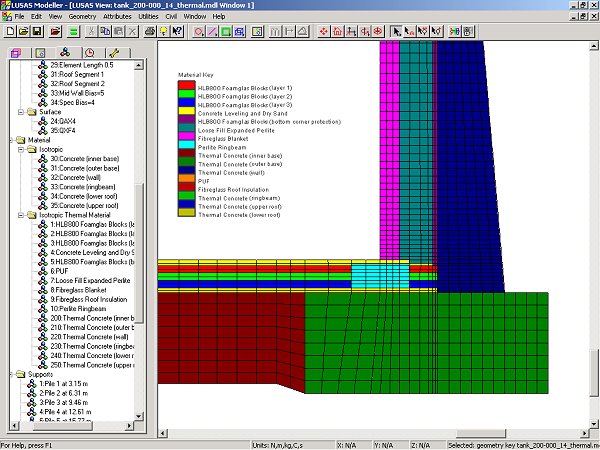
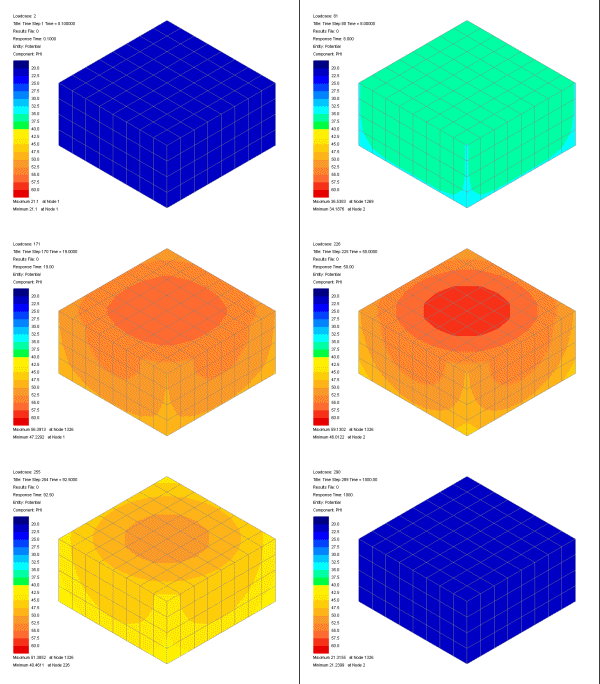
The Thermal
/ Field software option contains extensive facilities for both
simple and advanced steady state, and transient thermal / field
analyses. By combining the LUSAS Thermal / Field option with other
appropriate LUSAS options, heat transfer due to conduction, convection
and radiation can be analysed. In addition, the effects due to phase
change of material may also be included.
For large concrete
structures such as cooling towers, dams, caissons and other large
foundation bases, steady state and transient thermal analyses can be
done with or without thermal-structural coupling. Modelling of heat of
concrete hydration can be done for a variety of cement types using the
using the Heat of Hydration option.
Heat
of hydration
|
Modelling
of heat of concrete hydration can be carried out for a variety of
cement types using the using the Heat
of Hydration software option. Effects due to the addition of fly
ash and ground granulated blast furnace slag can also be included.
When used in conjunction with Nonlinear, Dynamic, and Thermal software
options the heat of concrete hydration can be computed during a
thermo-mechanical coupled analysis and the temperatures and degree of
hydration can be read in to the mechanical analysis.
|
|
Continue the
tour...
Find out more
|