Case Study
Share this
article
Wooden
Tower, Helsinki Zoo
- Wooden lattice structure
- Ultimate and
serviceability limit state checks for applied loadings

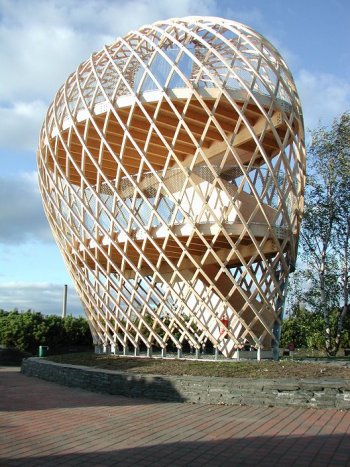
The wooden observation tower at
Helsinki Zoo in Finland was the winning design in a competition
held for architectural students of Helsinki
University of Technology. Situated on a small island just
outside the city, and built on one of its highest hills, it
provides visitors to the zoo with panoramic views over the sea and
surrounding area. LUSAS Civil & Structural was used in
the design and analysis to prove the safety and structural
behaviour under imposed loading.
|
Overview
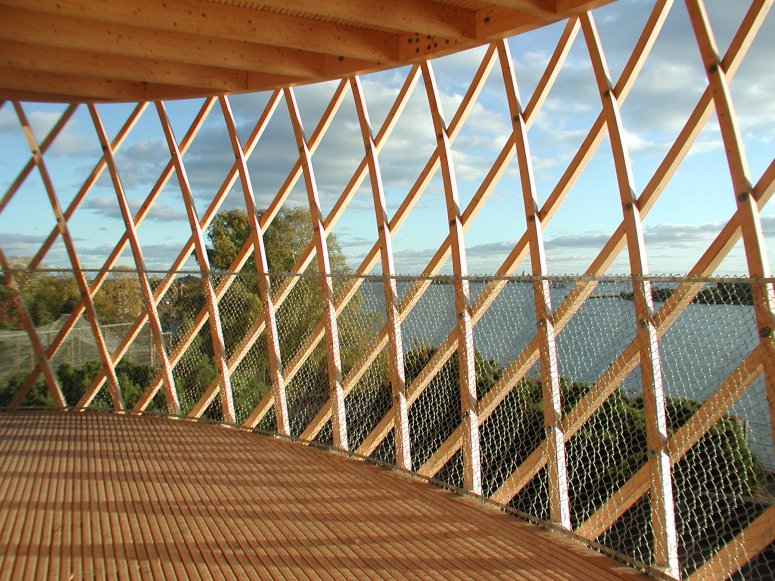
Similar in structural form to
the Downland
Gridshell at the Weald and Downland Open Air Museum in
Singleton, UK, but far smaller in scale, the Helsinki
University tower is a 10m high, two storey,
irregular-shaped wooden lattice structure built from 72, twelve
metre long, glue-laminated battens. The battens were factory bent
to 7 different preformed shapes ready for assembly but to achieve
the final shape they had to be bent and twisted further during the
construction process. The wooden members are connected with
double-sided nail plates and 10 mm through-bolts to form a space
truss. In all, there are more than 600 joints in the tower. Two
floor levels are supported by edge beams at the perimeter and
connected to the truss by deck bolts to give the necessary
horizontal stiffness and support to the lattice members. A steel
framed opening in the shell provides access to wooden stairs. The
whole structure rests on a hidden reinforced concrete foundation
via specially designed steel joints. |

|
| |
|
|
Modelling and
analysis
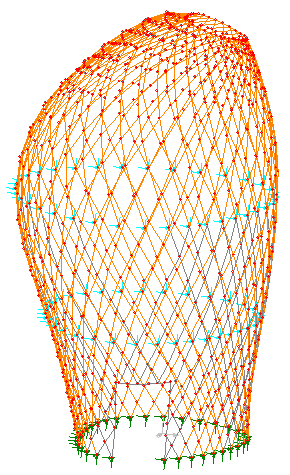
A 3D CAD model of the architects
complex irregular geometry was imported into LUSAS using the DXF
interface. Supports, loading, and section properties were defined
to enable a full structural analysis using 3D beam elements to be
carried out. Lauri Salokangas of Helsinki University said:
"We found the ability of LUSAS to import CAD files extremely
useful. It saved us a great deal of time in re-creating the model
in LUSAS".
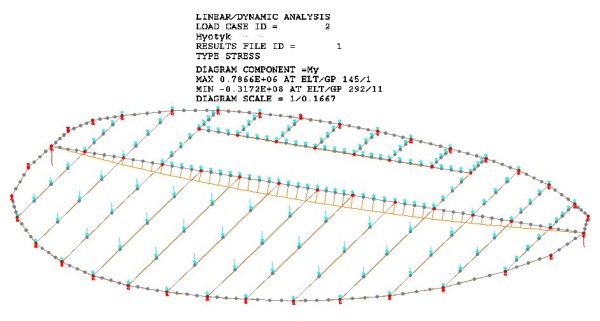
In the Ultimate Limit State the
maximum compressive normal force obtained due to most unfavourable
load combination of self weight, live load and wind load, was
17.8kN. The corresponding stress in the most stressed member was
about 5 N/mm2, well below the compression strength for wooden
laminates. No cause for alarm was found with regard to sideways
buckling in the most stressed lower struts.
In the serviceability analysis
LUSAS was used to determine the stiffness and frequencies of
the structure. In spite of individual slender members the
structure turned out to be very stiff in the vertical direction.
Serviceability Limit State loadings caused only a few millimetres
deflection on the floor levels. This was also experimentally
verified in a load-test on the finished tower, where an applied
load of 21kN on the first floor caused only a 5mm deflection.
The eigenvalue analysis showed that
the fundamental frequency in the weaker horizontal direction was
about 5Hz. This corresponded reasonably well with the measured one
of 4.5Hz on site.
|

|

"We found the ability of LUSAS to import CAD files extremely
useful. It saved us a great deal of time in re-creating the model
in LUSAS." Lauri Salokangas,
Helsinki University
Share this
article
Other LUSAS Civil &
Structural case studies:
|
|
Software Information
|