 Case Study Case Study
Initially Proposed Mississippi River Bridge
- Proposed record-breaking cable stayed road bridge
- Detailed advanced 3D
nonlinear and dynamic analysis
- Staged
construction incorporating creep and post-tensioning
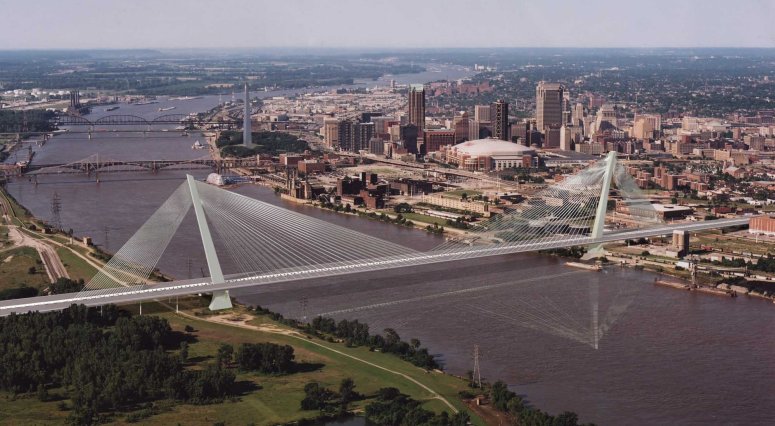
If it had been built, the initial
proposed New
Mississippi River Bridge would have been a record-breaking, cable-stayed structure linking the
States of Illinois and Missouri in the USA, helping to relieve traffic on other bridges
across the river. The designer, Modjeski and Masters,
was chosen by the Illinois and Missouri Departments of Transportation to perform
both the bridge-type study and to provide preliminary and final design for the proposed crossing.
Facts and figures
- At 222 feet (68m) in width, the Mississippi River Bridge
would have been the
world’s widest cable-stayed structure.
- It was designed to carry eight traffic lanes with shoulders that provided for four
additional lanes in the future.
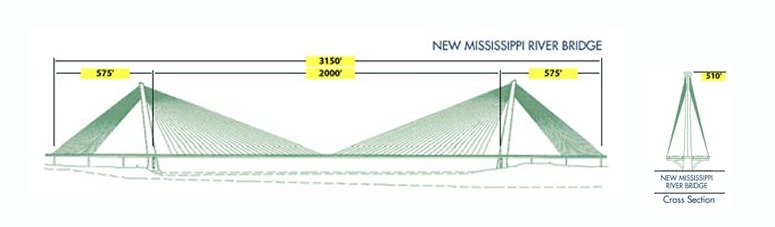
- The total length of the bridge
was approximately 3,150 feet (961m).
- The main span of 2,000 feet (610m)
would have been the longest clear span across
the Mississippi River, the longest cable-stayed span in the Western hemisphere and the
fifth-longest cable-stayed span in the world.
- Two 510 foot (155m) high single pylon towers
soared 435 feet (133m)
above the roadway.
- It would have been the first major cable-stayed bridge to use three planes of
cables in the main span.
|
|
|
Modjeski and Masters used LUSAS Bridge to assist with
a number of global and local analyses of the structure because of the advanced 3D
nonlinear, dynamics and staged construction facilities that it offers for this type of
work.
Analyses with LUSAS Bridge
included:
- Static analysis under dead loads
|
- Moving load analyses, including fatigue load
determination
|
- Nonlinear static stability analyses of the free-standing
towers and of the completed bridge
|
- Frequencies and mode shapes
|
- Spectral earthquake analyses in 3D
|
- Modelling of creep in the concrete towers during
construction and in service to model code CEB-FIP90
|
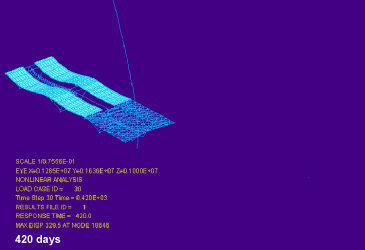
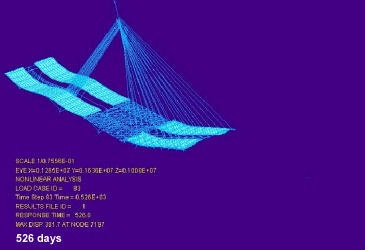
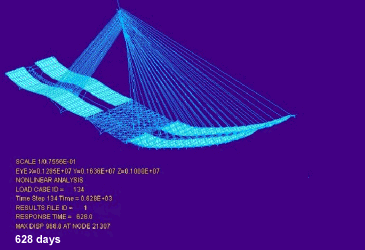
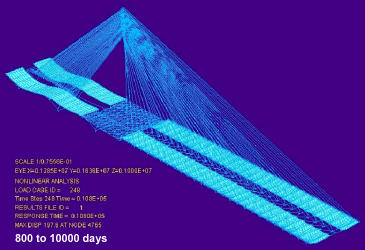
- Staged construction analysis of the deck erection
sequence
|
- Detailed analysis of forces in cellular concrete
components
|
- Detailed analysis of steel plate stresses at connections
and cable anchorages
|
Staged construction
modelling
Following costings an alternative
crossing solution was sought.
Find out more
Other LUSAS Bridge case studies:
|
|
Software Information
|