Case Study
Namdo
Bridge
- Nielsen arch road bridge
- local analysis of arch / girder connection
- linear static analysis to optimise stiffener design
LUSAS Bridge has been used by Sambo Engineering Co Ltd to investigate
localised stress distribution in a steel arch rib and girder connection for the Namdo
Bridge in Whagae-Myun , Junlanam-Do, South Korea.
Overview
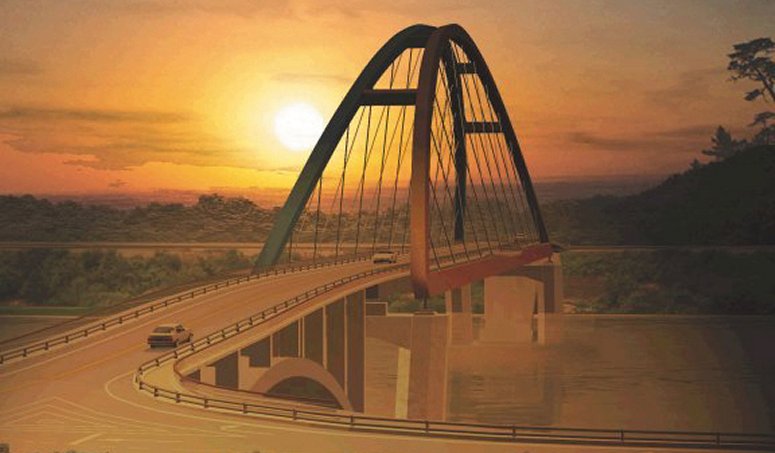
Namdo Bridge is a 160m span, 32m high Nielsen arch bridge that carries a
2 lane highway across the Seomjin river. It comprises a pair of 1.8m deep inclined steel
connecting arches that support the 2.2m deep longitudinal steel box girders via cables
inclined at 60 degrees. The angled cables help to transmit some of the internal forces in
the stiffening girders back into the arch giving a stiffer structure with reduced deck
deflections than for similar bridges with a vertical cable arrangement. At the junction
where a longitudinal girder meets an arch rib large stresses are involved and careful
detailed design of the web stiffeners is required in order to avoid high stress
concentrations and potential fatigue problems.
| Joonsang Son, an engineer on the
project explains: "If the web thickness is increased excessively it can cause high
residual stresses in the welds, and increase the possibilities of brittle fracture.
Alternatively, if an excessive number of stiffeners is used then the structure becomes
more awkward to fabricate. Therefore it is very important to accurately predict the
stresses involved either by laboratory testing or by structural analysis using LUSAS
Bridge".
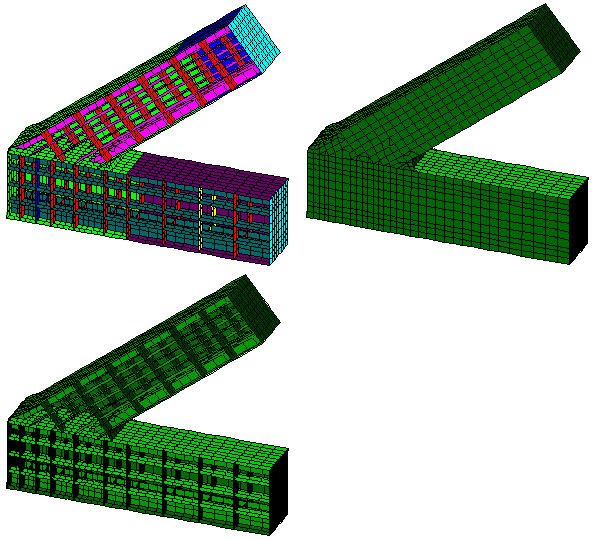
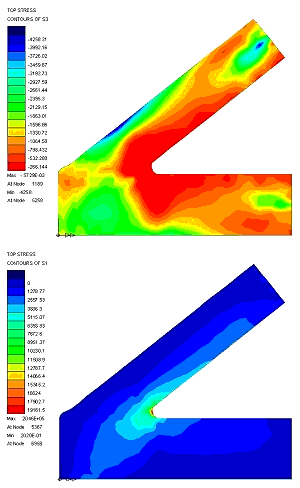
A local model of the connection was built in LUSAS Bridge using thick
shell elements. Dead load, surfacing load, live and wind loading was applied prior to a 3D
static analysis being carried out. Results plots showing tensile and compressive principal
stresses and shear stresses in the webs and plates helped Sambo Engineering Co Ltd to
optimise and prove their design. |
|
|
|
|
Joonsang Son says: "We examined
the flow and amount of stress near the end of the stiffening girders very thoroughly using
LUSAS and showed that the stresses near the end of stiffening girder were less than the
allowable stress". He continues, "LUSAS is good at modelling this kind of
problem. Its shell and solid elements are easy to use, and the ability to plot results on
selected parts of the model allows us to check the stress levels in a very straightforward
manner. This is one of the many benefits in using LUSAS on this and other projects".
The bridge is scheduled for completion in late 2002 for clients the
Administration hall of Junlanam-Do / Administration hall of Kyungsangnam - Do
|
|
"LUSAS is good at modelling this kind of
problem. Its shell and solid elements are easy to use, and the ability to plot results on
selected parts of the model allows us to check the stress levels in a very straightforward
manner. This is one of the many benefits in using LUSAS on this and other projects".
Joonsang Son,
Engineer, Sambo Engineering
Find out more
Other LUSAS Bridge case studies:
|
|
Software Information
|